


Presenting at a conference or webinar can seem daunting, but there are ways to reduce your fear of public speaking. My tips on preparing for and talking at your next event will help calm your nerves.
The first time I spoke at a conference, I was extremely nervous, to say the least. I had previously led training sessions and given short presentations in my employed life, but to represent myself as a freelance editor to fellow professionals (both online and in the room) was a whole other ballgame.
As my talk at the annual CIEP conference edges closer, I’ve collated everything I do to prepare and deliver a smooth, nerve-free (well, almost!) presentation into this blog post. Not all these ideas will work for everyone. Take what you think will be useful for you.
Let me know in the comments what advice you found most helpful, and share your own ways of preparing for talking at an event!
Why speak at an event or webinar?

If you’re unsure whether it’s worth the time, effort and anxiety to speak at a conference or other event, consider the advantages.
Increased self-confidence
Once you’ve finished your talk, you’ll feel you can conquer any challenge that life throws your way! Positive feedback about your presentation will also boost your confidence for future talks.
You’ll learn how to deal with feelings of anxiety and learn more about yourself as a result.
Exposure/kudos in peer community
People will see you as an authority on the topic you’re speaking about (because you are!). You’ve stuck your head above the parapet, so more people in your community will know who you are. This can lead to new opportunities.
More clients/sales
More exposure can lead to a fresh pool of clients or sales. Even if you’re presenting to peers rather than target clients, this can lead to referrals.
I usually plug my books at the end of my talks, and it always leads to a few copies being bought.
Payment or reduction in registration costs
Many speaking opportunities are paid gigs. If you were planning on attending the event anyway (e.g. a conference), your ticket price is likely to be reduced if you’re talking.
Content to use for future marketing
Once you’ve spoken at an event, you can use this fact in your online marketing. If you can source photos of yourself presenting, even better!
How do I create a talk or presentation?
The blank page can seem unforgiving. Break down the creation of your presentation into bitesize steps, and it will take shape before your eyes!
- Decide which program to use, e.g. Canva or PowerPoint. You can create your slides in Canva and download as a PowerPoint file if you prefer. (That’s what I do!)
- Decide on a topic (if you haven’t already) and a catchy title. The event may have a theme, so ensure your idea is within the bounds of that.
- Draft a rough structure as bullet points. This will help you to get the flow right before you dive into the creative side of things.
- Create a template using your brand colours and fonts. You can base this on one of the many templates that Canva and PowerPoint provide, to save doing it all from scratch. This will give your slides a professional look and feel.
- Start to populate your presentation. Don’t have too much text on each slide, as they will look too busy, and people will be reading the text instead of listening to you. Depending on the nature of your talk, include lots of visuals and inject a bit of humour here and there if you feel comfortable doing so. Think about what keeps you engaged when you’re listening to a talk.
- Once you have the bare bones in place, do a draft run-through for flow and timing.
- Finalise your slides.
How do I prepare for my speaking gig?
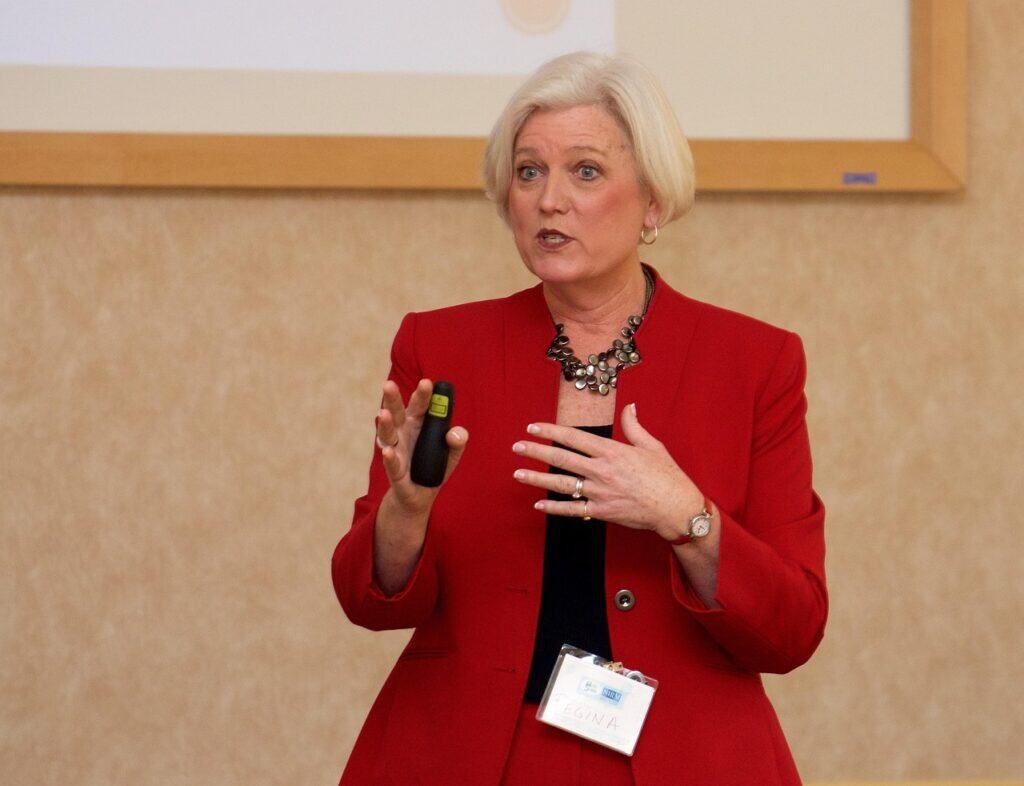
Practise, practise, practise.
Preparation is key. If you enter the room on the day knowing you’re unprepared, you’ll feel more nervous and out of control than if you have done ample prep.
First and last words
Spend more time going over the very first and last words you will say. This makes for a smooth beginning and end, and will help to calm your nerves at the start.
I often find my mind goes blank when I’m nervous. If you’ve rehearsed the first couple of sentences until they’re second nature, you’ll find it easier to relax into your talk.
Time yourself
Confirm with the organiser how long your speaking slot is and whether that includes time at the end for questions. Allow around ten minutes for questions, unless the organiser says otherwise.
Use a timer with every full run-through and note the rough timestamps you’ll need to hit for each section. That way, you’ll know if you’re running a bit slow or fast during the actual presentation, and you can make small adjustments to get back on track.
Lots of small ad-hoc elements add up fast, leaving little to no time for questions at the end, or even worse, you’ll have to cut out whole sections.
Try to avoid reading every word
If possible, try not to read a script, especially if presenting in person (rather than online). However, if this is the only way you will get up there and do it, by all means have one.
Bear in mind to keep looking up at your listeners, though, and use methods that help you to avoid losing your place (e.g. large font and double-spaced text, subheadings, move thumb down to where you are if using paper notes).
Learn from the best
Watch recordings of engaging speakers (Ted Talks are a good source) and make notes on why you feel they did a great job. Is it their stance, their way of speaking, their expressive tone? Try to emulate this in your delivery.
Also notice things that don’t work in other presentations. Can you tell if the speaker is nervous, or do they appear confident? What makes them appear this way? Remember that even speakers who look in control and calm are probably feeling nervous inside; they’re just doing a good job of masking it.
Record yourself
Record yourself going through your presentation every single time you rehearse. This will get you used to being recorded (if the actual event is being filmed).
It will also allow you to see if you have any physical or verbal tics you weren’t aware of. We all have them! Two of my favourite words are “umm” and “obviously”, which I didn’t realise until I watched myself talking!
Notice your sticking points
After a few run-throughs, note where you trip up or hesitate. Which slides do you dry up on or have trouble explaining? Practise these more often than the others until they’re smooth.
Make everything as familiar as possible
If you’ll be delivering a webinar, practise in the same room you’ll be presenting in, using the exact equipment you’ll use on the day (e.g. computer, microphone, ring light, external monitor). This will make everything more familiar when the time comes and reduce the likelihood of technical issues.
If you’re presenting in person, have a full dress rehearsal. Wear the clothes and shoes you’ll be donning on the day, and stand up if you’ll be on your feet.
I connect my laptop to the living-room TV and speak to the sofa, imagining an audience. Seems silly, but it helps everything to be that bit more familiar on the day.
Another way to gain familiarity ahead of your talk is to visit the seminar room or auditorium beforehand if possible, to take in the space.
Know where and when your talk is
Check exactly where your talk will be (in some cases, you won’t know this until the day) and when it is due to start. The organiser will tell you how far in advance you need to show up.
If you’re giving a hosted webinar, it’s likely you’ll need to connect 10–15 minutes ahead of time. The host will let you know.
Similarly, if you’re presenting in person, you’ll need to be in the room 10–15 minutes early, maybe more. Check this information with the organiser.
On the day
When the day arrives, there are some final preparation techniques to help everything run smoothly.
Be kind to yourself
Whether you’re feeling unusually calm or your anxiety is through the roof, go with it. Observe your emotions and physical feelings, knowing that it’s all perfectly normal.
See the section How to calm nerves when presenting.
Have a final rehearsal
If time allows, have one final run-through. This doesn’t work for everyone, as it can make some people feel more nervous, especially if they lose their place or get in a mix-up. As long as you’ve done plenty of prep beforehand, as described above, you’ll be fine.
Have water to hand
If you’re presenting in person, the organisers are likely to have water at the ready. Consider putting a bottle in your bag in case none is available.
If you’re presenting a webinar from home, remember to have water to hand. It’ll be too late to pop to the kitchen and grab a drink once you start.
Arrive in plenty of time
Give yourself plenty of time to arrive at the room in which you’ll be speaking. I like to find the room the day before (if it’s a conference over several days), or earlier in the day so that I know exactly where I’m going when the time comes.
How to calm nerves when presenting
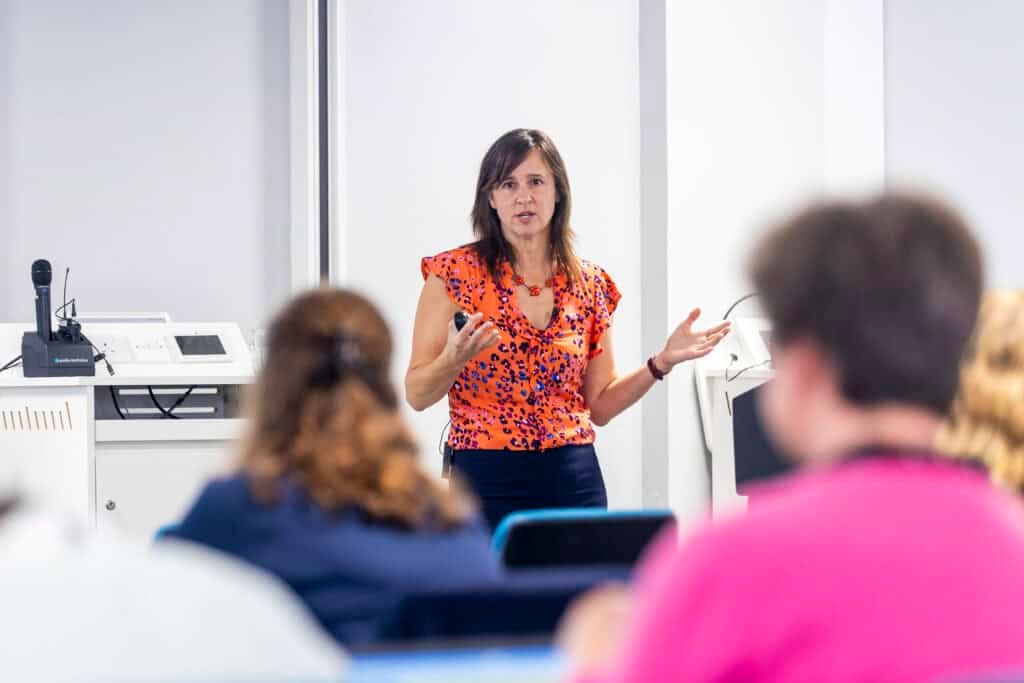
You may find that your nerves disappear as soon as you start talking. Or they may be present throughout.
I’ve developed a few techniques to calm my nerves before and during a presentation.
Tell yourself you’re not nervous but excited
We believe the stories we tell ourselves. While these stories are often negative, we can harness this trait and turn it to our advantage.
I tell myself I’m not nervous, I’m excited. This works because both emotions cause a similar physical reaction (butterflies, shakes, fast breathing). You may find you can’t wait for your talk to start!
Know that feeling nervous is normal
Feeling nervous or anxious is unpleasant but not dangerous. Your brain is wired to interpret these feelings as a threat because a tiger may be about to jump on you (our modern lives have evolved much faster than our brains). However, most conferences keep tigers out of the auditorium, so tell your brain it’s safe and can stand down.
Thoughts are just that: thoughts. Just because you worry that your talk will go wrong, doesn’t mean it will. Thinking something won’t make it happen.
Nerves are actually good because they will sharpen your focus and help you perform well.
Do some physical exercises
You may not want to do this one with people watching, but try a power pose before your talk (in the toilet/restroom is fine!). Stand with your feet apart and stretch your arms up and out at an angle. This sends signals of confidence and control to your brain. You could even imagine you’re on top of a mountain with the whole world at your feet. You’ve got this!
Take slow, deep breaths to calm your nervous system. There are different techniques, but one is to breathe in for a count of four, hold for a count of four, and breathe out for a count of four. You may find this instantly calms you.
Remember how you feel as an audience member
The audience is on your side; they want you to do well in your presentation (unless you’re an unpopular politician).
Remember the talks you’ve attended as an audience member. You would have regarded the speaker as just a person talking, with no reason to be nervous. You’re in their position now, and you have no reason to be nervous either.
Use confident body language
People are not mind readers. They won’t know you’re nervous if your body language tells them you’re confident. Stand tall, smile, and don’t rush.
Speak slowly
Slow down. If you hesitate or trip up, don’t panic. The pause will feel far longer to you than it is in reality. You can test this by watching recordings of your rehearsals.
I’m amazed sometimes when I think I’ve paused for five seconds because my mind has gone blank, but it’s only been two at the most and barely notices! The audience can’t see inside your head.
What to do after your presentation
You did it! All the preparation for your speaking gig paid off, it went smoothly, and now you can relaaaaxxxx.
Reward yourself
If possible, schedule some time after your talk to decompress and do something nice, however small. You’ve earned a treat.
Don’t mentally revisit any hiccups
If there were some less-than-smooth moments during your talk, don’t dissect these after the event. They’re in the past, and you may find people didn’t notice anyway. Focus on what went well, congratulate yourself for that, and move on!
Source photographic evidence
If the event had a professional photographer, ask the event organiser if you could have a copy of any photos taken during your talk. Check they’re happy for you to use these on your website and socials, and that there are no copyright restrictions in place.
Book your next speaking engagement
Now you’ve done it, there’s no stopping you! Do some online research to find the next event at which you can share your expertise, and go for it!
Need more help with public speaking?
I offer mentoring for editors to help them succeed in their editing business. I will happily run a Power Hour or a trio of sessions to help you prepare for and practise your speaking engagement. Find out more about my business mentoring for editors.
A selection of my speaking engagements
I, Human. Using your website to showcase the value of a human editor
21 September 2025, CIEP conference 2025
Why you need a professional editor or proofreader (they just spot typos, don’t they?)
17 July 2025, CIEP webinar
📹 Watch this webinar
Website development for editorial professionals
25 June 2025, EFA STET talk – webinar
Your editor website is not IKEA. How to attract, retain and convert visitors
8 September 2024, CIEP conference 2024





How to use social proof to sell more books or attract more clients
You are more likely to sell your book or your services if people see that...